
A late start on collecting polymer banknotes

It started with a gift
In September I walked into the MIF coin fair without a plan to start any new hobby. I walked out thinking about a banknote collection. Or at least the beginning of one.
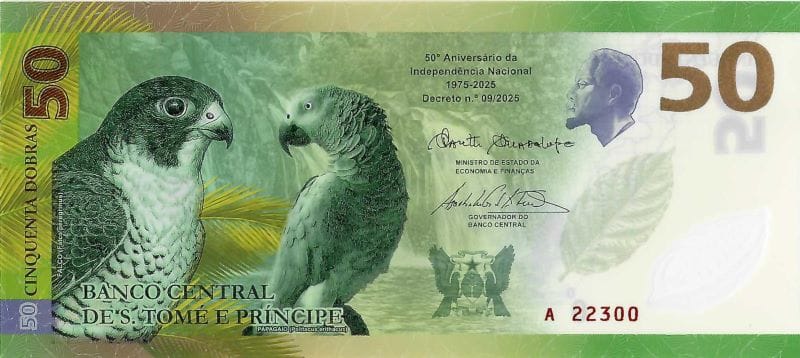
The trigger was a small gift: a commemorative 50 dobras note from São Tomé and Príncipe, dated 2025, printed on polymer. One moment it was just a polite gesture from a friendly seller. The next moment I was standing there holding it up to the light, turning it around, tracing the transparent window with a thumb and realising: this is actually interesting.
Paper money is familiar and increasingly background noise. This felt different. More like a designed object than a payment instrument. That one gifted note quietly flipped a switch.
Why polymer pulls me in
Polymer notes feel like someone took the idea of money and ran it through an industrial design lab. The material is thin but tough, slightly slippery, almost too clean. The colours sit differently on it. The transparent windows and layers make you want to tilt and poke and inspect.
Paper notes have their own charm: the wear, the soft edges, the history soaked into the fibres. But starting from zero at 57, I am not chasing childhood nostalgia. Polymer feels like a fresh entry point. It is money as a modern product, not just a historical artifact.
What stood out at the coin fair
The MIF fair was a reminder that every niche has its own ecosystem. Rows of tables, magnifying glasses everywhere, careful hands, and a lot of quiet negotiations over very small objects.
I wrote about this earlier in From hobby banknote app to an enterprise AI pitch.
The banknote sellers were a minority between the coins, but they brought more colour. Albums instead of trays. People flipping through sleeves the way others flip through vinyl records.
Walking around with that one gifted polymer note in my pocket, I noticed how quickly your brain starts filtering. Suddenly every polymer note on a table jumps out. Every transparent window catches the eye.
Polymer-first on purpose
Starting a collection at 57 has one advantage: you know your own tendencies a bit better. I am not trying to build a complete historical archive. I am trying not to build a storage problem.
So the decision is simple: polymer first. Not polymer only, but polymer as the spine of the collection. That constraint helps.
It gives a clear filter when looking at a table full of notes. If it is polymer and visually interesting, it might be a candidate. If it is paper, there has to be a very specific reason to care.
More on this in my article Why I finally deleted NotePlan.
It also keeps the collection anchored in a specific era of money. Polymer notes mark a certain technological and economic threshold for a country. You get a quiet map of who decided to modernise their cash and how they chose to present themselves on it.
Keeping it a curiosity, not a compulsion
The dangerous part of any collecting hobby is the slide from curiosity to compulsion. You can almost see the slope: from a few favourite pieces to filling series, to chasing variants, to buying because you do not want a gap in a binder.
Starting at 57, I do not need another structured way to spend money on things that sit in a closet. I want something that stays light and interesting.
So the guardrails are simple in my head. No investment story. No completion goals. Small, visible storage. Enough to keep the curiosity alive without turning it into a spreadsheet hobby.
What a single note can start
There is something satisfying about starting a new interest this late with something this small. No big gear purchase, no course, no plan. Just a gifted 50 dobras note from São Tomé and Príncipe, printed on polymer, handed over at a table in September.
Read also Three things I delete from almost every AI draft.
From there, the questions come naturally. Which countries are switching to polymer? How do designs change when you move from paper to plastic? What does a country decide to show on its money when it has more visual freedom?
That feels like enough of a reason to keep going for now. Not a collection to finish, just a stack of small, carefully designed excuses to keep paying attention.
Subscribe to my newsletter to get the latest updates and news



Member discussion